
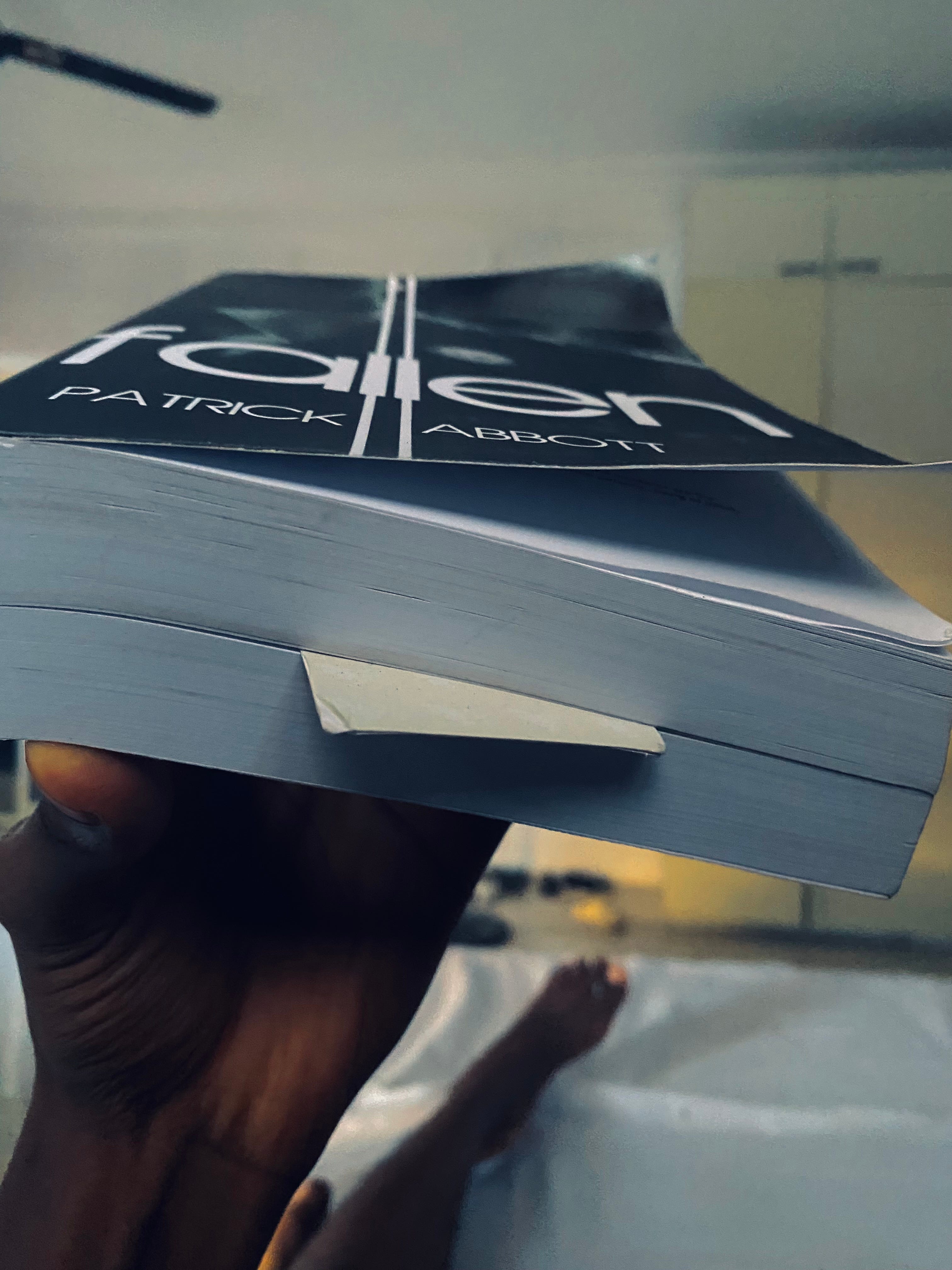
“Fallen” by Patrick Abbott
Book Review

For those who’d rather watch me speak, click below to watch on YouTube. Also, I encourage you to subscribe if you’re a lover of books.
Last month, I DNF’d Fallen by Patrick Abbott, Sci-Fi Author despite reading almost to the very end. Today, I want to talk about what I enjoyed, what worked for me, and the elements I simply couldn’t push through.
This will be a longer review, so settle in.
The Premise
Fallen is a military science-fiction novel. The story follows Brendan Sean Murphy, an intelligence officer, diplomat, and soldier who is struggling with severe PTSD and survivor’s guilt. He is also dealing with the fallout of a toxic ex-wife.
Hovering over all of this is an alien race known as the Sabia, whose presence forms the central tension of the novel.
On paper, it’s an interesting and arresting premise — one that should naturally generate urgency, fear, and political instability. To Abbott’s credit, the idea itself is strong. His writing also maintains a polished, almost lyrical quality that makes the novel easy to read on a sentence-by-sentence level.
There is also a noticeable structural ambition here, which is the attempt to bring together psychological trauma, military protocol, and alien diplomacy. This is no small undertaking, and I could clearly see what the book was aiming for.
Where the Novel Lost Me
The area where the novel consistently began to lose me was its characterisation.
The reactions of the characters simply did not feel real to me. Once verisimilitude breaks at the level of character, it becomes very difficult for me to remain invested, no matter how compelling the premise may be.
Many of the emotional beats felt indicated rather than genuinely embodied. The breakdowns, in particular, often came across as staged, occurring where they should in theory, but lacking the unpredictability and texture of actual human responses, especially given the psychological weight the narrative assigns to them.
This issue extends beyond Brendan to the wider cast and even to institutional behaviour.
The Government’s Response
The government’s response to the Sabia is where the lack of realism became hardest for me to overlook.
There is a kind of detached calm in the face of what should be an existential anomaly.
Picture it: an alien race is hovering above Earth. Rationally speaking, there should be political turbulence, social upheaval, and widespread psychological consequences. Instead, the world feels oddly adjusted to the situation, as though this level of disruption has been absorbed without friction.
That normalisation is not sufficiently justified within the narrative, and as a result, it weakens the stakes.
The Aliens Themselves
I had similar reservations about the portrayal of the Sabia.
I understood the intention behind the alpha-female social dynamic, and I genuinely respected the effort to establish a gender-role inversion. It’s a concept that can work very well.
I immediately thought of Herland, a novel by Charlotte Perkins Gilman, which I thoroughly enjoyed precisely because of how convincingly it built and sustained that inversion.
Here, however, the execution did not fully land for me.
The Sabia, particularly in their behavioural traits, felt too familiar. Their characteristics read as largely human, without enough alien distinction to make the dynamic feel fully realised.
So while I understood the concept, it never quite convinced me on a functional level.
I also struggled with the fact that I did not have a clear sense of what these aliens looked like until I was roughly halfway through the book. I personally enjoy having a visual sense of important characters much earlier in a story.
The Pacing
Then there is the pacing.
I genuinely tried to give this book every benefit of the doubt. I read all the way to page 603 of a 663-page novel, but the plot continued to drag.
At that point in a book — especially one of this length — I expect a clear sense of momentum or escalation. Instead, it often felt as though the story was circling its own ideas rather than pushing them forward in a meaningful way.
That lack of progression, combined with my growing disconnection from the characters, made it difficult to justify finishing the final stretch.
Final Thoughts
Ultimately, this was a near-complete read that still ended in a DNF for me.
There is a lot here to appreciate on a technical level, particularly in the writing style and the ambition of the novel’s structure. However, the lack of convincing character reactions and the uneven handling of its central speculative elements made it a difficult experience for me to fully engage with.
My copy of the book was provided directly by Patrick Abbott, and I appreciate the opportunity to read it.
DNF at page 603 of 663.
You can support my writing by buying me a coffee and/or showing me love.
You can also check out my eStore here: Selar